Hybrid electric water heaters in Newark and Essex County
Heat pump water heaters in Newark, NJ
A heat pump water heater takes warmth out of the basement air and puts it into the tank. Whether that pays off depends on the room it stands in and the fuel it replaces.
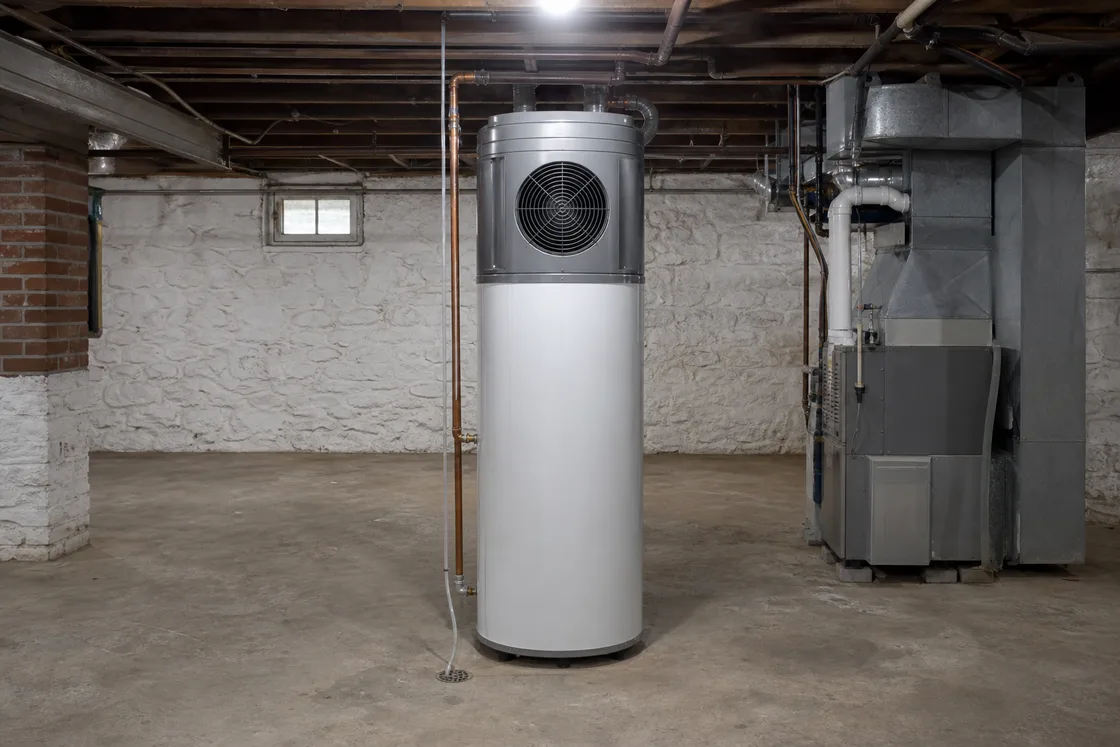
Where a heat pump water heater fits in a Newark house
ENERGY STAR describes a heat pump water heater as a refrigerator working in reverse: it "takes the heat from surrounding air and transfers it to water in an enclosed tank." So the room it stands in matters as much as the model, and the first question about any heat pump water heater in Newark, NJ is where it will go.
ENERGY STAR's buying guidance asks for an indoor space that stays between 40 and 90 °F all year, with 1,000 cubic feet of air around the heater. Makers set their own minimums, and they can be smaller. A. O. Smith's Voltex manual asks for at least 450 cubic feet of room air, or as little as 84 cubic feet with a louvered door or wall grilles, and no minimum at all if the unit is ducted in and out. For scale, a room 10 feet by 10 feet with an 8-foot ceiling holds 800 cubic feet.
Temperature, drainage and power decide the rest. In heat pump mode the Voltex needs the surrounding air above 37 °F and below 120 °F; outside that range its electric elements take over and the heat pump stops running. The unit makes condensate, and the manual says the line must run to a suitable drain or to a condensate pump. And the standard Voltex needs a 208/240-volt, 30-amp supply. A. O. Smith also sells a 120-volt model that plugs into a standard grounded outlet and is certified for a shared circuit, which matters in a basement with no spare heavy circuit.
It also cools the room. ENERGY STAR says these units "can cool the spaces they are in", and in hot, humid months "help cool and dehumidify the space it is installed in." In a damp basement in August that is a bonus. In a cold space, ENERGY STAR says, these units generally run less efficiently, so it suggests a room with spare heat, such as a furnace room, where you have the choice.
Hybrid water heater or heat pump water heater?
They are the same thing. ENERGY STAR says heat pump water heaters "are also commonly referred to as Hybrid Electric water Heaters." The hybrid part is the backup: during heavy hot water use they "switch to standard electric resistance heat" on their own. ENERGY STAR lists the modes their control panels offer:
- Efficiency or Economy: the heat pump only, for the lowest running cost.
- Auto or Hybrid: the default, heat pump first with the elements helping when demand is high.
- Electric or Heater: the elements only, the least efficient setting.
- Vacation and Timer: on some models, a sleep setting while you are away.
To carry the ENERGY STAR label, an integrated heat pump water heater needs a Uniform Energy Factor of at least 3.30, or 2.20 for a model built for a 120-volt, 15-amp circuit, and a first-hour rating of at least 45 gallons. For comparison, a certified gas tank of up to 55 gallons needs a UEF of 0.81 on the medium draw pattern. ENERGY STAR's glossary says the higher the UEF, the more efficient the heater.
What a heat pump water heater costs, and what it saves
| Publisher | What the figure covers | Figure |
|---|---|---|
| Doctor Water Heater, a New Jersey installer (national table, published December 2025) | Hybrid or heat pump unit plus installation labour, US national averages | $2,000 to $6,300, about $3,000 on average |
| ENERGY STAR | Extra purchase cost over a standard electric tank, used in its payback sums | $1,503 |
| ENERGY STAR | Yearly saving for a household of four against a standard electric tank, at $0.146 per kWh | About $550 |
| PSE&G | Post-purchase rebate on an ENERGY STAR certified unit, as of September 2026 | $750 |
Read the third row carefully. ENERGY STAR's saving, and its payback of about three years for a household of four, compares a heat pump unit with a standard electric tank. If the heater you are replacing burns gas, that comparison does not hold as written, and the running-cost case has to be made against your gas bill instead.
The federal tax credit that used to cover heat pump water heaters no longer applies to a new install. The IRS instructions for Form 5695 say you can't claim the energy efficient home improvement credit "for expenditures or property placed in service after December 31, 2025." Some price pages, a manufacturer's among them, still mention it.
Converting a gas water heater to a heat pump
PSE&G supplies both gas and electricity in Newark, so a gas tank can be replaced with a heat pump unit. It is a bigger job than a swap:
- The unit needs its electric supply at the heater, either a 240-volt circuit or, for a plug-in model, a grounded 120-volt outlet on a circuit with room to spare.
- It needs a drain for condensate and the air volume above.
- A change of fuel is not the like-for-like replacement that New Jersey's minor-work rule describes, so the town's construction office decides how the permit is handled. Our guide to how the NJ water heater permit works explains the steps.
PSE&G's rebate needs an active PSE&G residential electric account, and the utility says commercial and multi-family properties are not eligible. If you own a two- or three-family house, ask PSE&G how it classes yours before you count on the money.
If the numbers do not work for your house, a straight water heater installation in Newark with the same fuel is the simpler job, and a like-for-like swap is the one New Jersey lets start on notice.
How the PSE&G heat pump water heater rebate is paid
The rebate is claimed after you buy, not taken off the price at the counter. As of September 2026, PSE&G's rebate page sets out these steps.
- Buy an ENERGY STAR certified unit From any retailer, with a receipt that shows the full date Claim within 120 days of purchase
- Send PSE&G the claim An active PSE&G residential electric account is required
- PSE&G reviews it Eligibility and paperwork are checked About six weeks after review
- The $750 arrives Paid by check only
Heat pump water heater questions from New Jersey homeowners
Do heat pumps work well in NJ?
A heat pump water heater cares more about the room than the weather outside. ENERGY STAR's guidance is an indoor space that stays between 40 and 90 °F all year. It also says that in colder months, with colder water coming in, a unit may switch to its electric backup for a while, which raises energy use in those months. A basement that stays mild through a North Jersey winter suits one better than an unheated garage.
What is the downside of a heat pump water heater?
Mostly space and price. It wants more room than a gas tank, a place for its condensate to go, and it cools the space around it. It costs more to buy: ENERGY STAR's payback figures assume $1,503 more than a standard electric tank. ENERGY STAR also notes these units may need yearly maintenance, including changing air filters.
Can you convert a gas water heater to a hybrid heat pump water heater?
Yes, though it is a bigger job than a swap. It needs electricity at the heater, a drain for condensate and enough air around the unit. A change of fuel is also outside the like-for-like replacement that New Jersey's minor-work rule describes, so the town's construction office decides how the permit is handled. How the NJ water heater permit works.
Can I install a heat pump water heater myself in New Jersey?
Only on a single-family house you own and live in. New Jersey's code says plumbing and electrical work may only be done by people licensed for it, except a single-family homeowner working on their own home (N.J.A.C. 5:23-2.15(b)2i). The permit and the inspection still apply either way.
Is there a rebate for a heat pump water heater in New Jersey?
PSE&G, the utility for Newark, offers a $750 rebate after purchase on ENERGY STAR certified heat pump water heaters, as of September 2026. You need an active PSE&G residential electric account, the claim goes in within 120 days of purchase, and PSE&G says commercial and multi-family properties are not eligible. The conditions are on PSE&G's rebate page. We only print figures we have read at the source, and PSE&G's is the one we could confirm.
How much does it cost to install a heat pump water heater in NJ?
A New Jersey installer's price page gives national figures of $2,000 to $6,300 for a hybrid unit, bought and installed, with about $3,000 as the average. It publishes no New Jersey figure for heat pump units. If you qualify, PSE&G's $750 rebate comes off that after purchase. The only price that counts is the one for your basement, so describe the heater you have and the space it sits in.
Where the figures on this page come from
- ENERGY STAR, heat pump water heaters: buying guidance, read September 25, 2026
- ENERGY STAR, heat pump water heater savings and benefits, read September 25, 2026
- ENERGY STAR, water heater key product criteria, read September 25, 2026
- A. O. Smith, Voltex hybrid electric heat pump water heater manual (PDF), read September 25, 2026
- A. O. Smith, Voltex 120V plug-in specification sheet (PDF), read September 25, 2026
- PSE&G, heat pump water heater rebate, read September 25, 2026
- IRS, Instructions for Form 5695 (2025), read September 25, 2026