Leaks, cold taps and noisy tanks in Newark and Essex County
Water heater repair in Newark, NJ
A tank that leaks, rumbles or runs cold is sometimes a worn part and sometimes the end of the tank. Make it safe first, then work out which one you have.
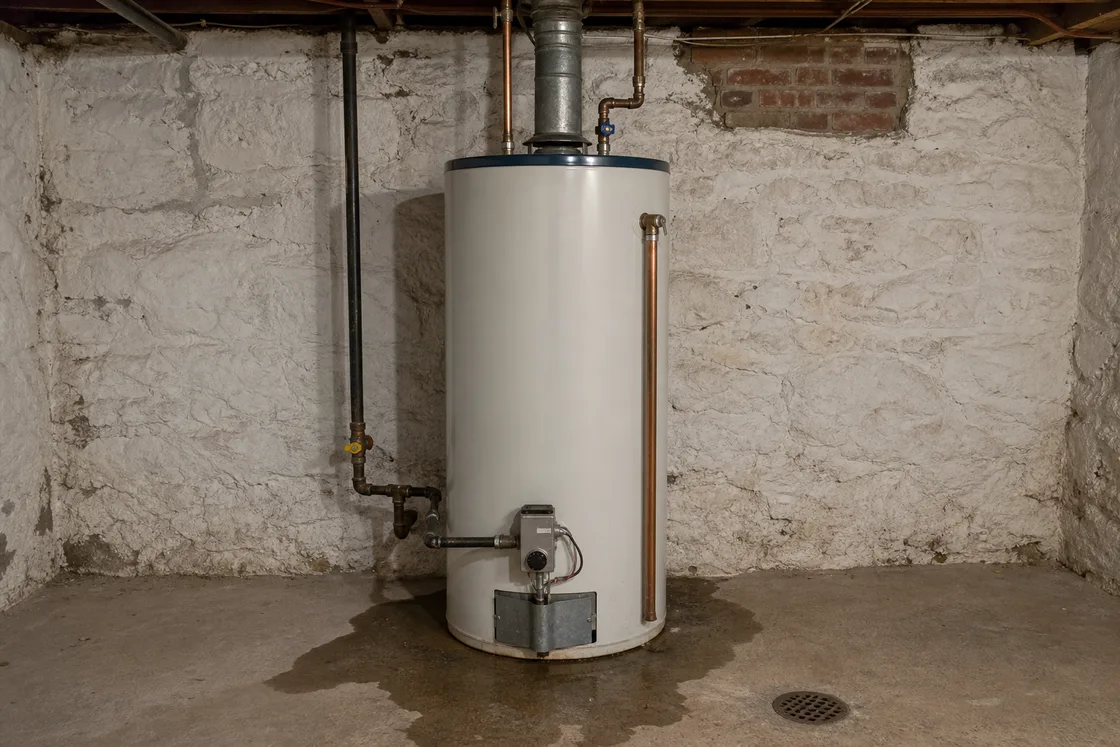
Water heater repair or replacement: start with the symptom
This page takes four signs that lead to water heater repair in Newark, NJ one at a time: water where it shouldn't be, no hot water, a new noise, and a relief valve that drips. Each has a likely cause. Some of those causes are a part and some are the tank itself.
If you smell gas, stop here. PSE&G's instruction is to leave the building right away, move at least 350 feet away, and only then call PSE&G or 911. A. O. Smith's manual adds: don't try to light any appliance and don't touch electrical switches. The details are on PSE&G's gas leak page.
Water heater leaking: what to do in the next ten minutes
First, make the heater safe and stop the water, using the steps the manufacturers give for draining:
- Gas heater: turn off the gas at the manual shut-off valve on the gas line, then move the gas control to off.
- Electric heater: switch off its circuit breaker. Rheem's manual says to turn the breaker off if the heater has been through flooding or overheating.
- Close the cold water valve on the supply line into the top of the heater.
- Move anything that matters away from the water. Both manuals open a hot tap in the house as part of draining, and a pro may ask you to do the same.
Then look at where the water is coming from.
Is it really a leak? Both manuals describe condensation that looks like one. On a gas tank, A. O. Smith says moisture from combustion can drip onto the burner with a "sizzling" or "frying" sound, that this "should not be confused with a leaking tank", and that it stops once the tank warms up, usually within one to two hours. Rheem says an electric tank can sweat when first filled or after a heavy draw of very cold water, and that if it continues you should check the pipes and fittings.
A fitting, a valve or the tank? A. O. Smith's heat pump manual notes that "leaks are frequently in the plumbing system itself and not the water heater", so check the pipe joints, the drain valve and the relief valve's pipe first. Water from the tank body is different. A. O. Smith's manual says that "due to the normal corrosive action of the water, the tank will eventually leak", and that once the anode rod is used up, "the tank will start to corrode, eventually developing a leak." A water heater leaking from the bottom, with no fitting above it wet, is where a repair question often becomes a replacement question, and that is worth asking the pro directly.
No hot water: gas and electric checks
Gas. Some gas tanks light the pilot automatically. The A. O. Smith model we read has an ON/OFF switch on the gas control, a status light that blinks "a heartbeat" when the pilot is lit, and a plain instruction: "Do not try to light the pilot by hand." It also carries two safety shut-offs that stop the gas. One is a flammable vapor sensor, which trips if the heater has been near spilled gasoline or paint fumes and must be reset by a qualified service person. The other is a thermal switch for poor combustion, such as a blocked vent. If your water heater pilot light will not stay on, or the status light shows a fault, one of those is a likely reason, and none of them is a job for a match.
Electric. Rheem's troubleshooting table for "not enough or no hot water" starts with the simple things: a tripped breaker or blown fuse, the power switched off at the disconnect, a thermostat set too low, a hot tap left running, or more hot water used than the tank holds. In winter, it adds, colder incoming water simply takes longer to heat. Then there is the high-limit control (ECO), which "will break the power circuit to the heating element" if the water gets too hot. Once it opens "it must be reset manually", and Rheem says the cause "must be investigated by qualified service technician" first. Its manual also says not to attempt repairs to wiring, thermostats or heating elements yourself.
Water heater making noise
A. O. Smith lists three sources of noise on a gas tank: metal expanding and contracting, condensation sizzling on hot surfaces, and "sediment buildup in the tank bottom", which it says "will create varying amounts of noise and may cause premature tank failure." Its manual recommends draining and flushing the tank every six months. On an electric tank, Rheem puts a rumbling sound down to scale on the elements, and suggests draining a few quarts from the tank every month to clear deposits.
A new rumble or pop on an older tank that has never been flushed is a sign to get it looked at, not always a sign the tank is finished.
Water heater relief valve leaking or dripping
The temperature and pressure relief valve is a safety device. A. O. Smith says its job is "to discharge water in large quantities in the event of excessive temperature or pressure", and the manual says: "If the temperature and pressure relief valve is dripping or leaking, have a qualified person replace it. … Do not plug valve. Do not remove valve."
A valve that lets go now and then, rather than dripping all the time, often points to thermal expansion. Rheem explains that a check valve on the incoming water line makes a "closed water system", and that heated water then raises the pressure. Both manuals name the fix as an expansion tank on the cold line. The discharge pipe itself has rules too: A. O. Smith says it must end no more than six inches above a floor drain or outside the building, with no cap or valve on it.
When water heater repair stops making sense
A flood or a fire settles it. A. O. Smith says a heater whose gas controls, burner or pilot have been under water needs replacing entirely, and so does one that has been through an ignition of flammable vapors.
Corrosion takes longer. The anode rod protects the tank and wears away as it does, and Rheem suggests pulling it once a year for inspection and replacing it when more than six inches of core wire shows. Once it is gone, the tank itself starts to corrode.
Short of those, it comes down to age and how often the heater has needed help. A second repair on the same old tank is a sensible moment to price a replacement alongside it.
If it comes to that, New Jersey treats a like-for-like replacement as minor work that can start on notice to the construction office, which in Newark is the City's Office of Uniform Construction Code. Our page on water heater installation in Newark covers the swap and what it costs. For a wall-hung unit, tankless water heater repair has its own page, because scale and flushing are a subject of their own.
Water heater repair questions from Newark homeowners
Is it an emergency if my water heater is leaking?
Treat it as urgent if water is spreading, reaching anything electrical, or coming from the tank itself. Shut off the fuel and the cold water supply first, as described above. A. O. Smith's manual says not to use a heater if any part has been under water, and to have it inspected; its view is that a heater whose gas controls or burner were submerged needs replacing entirely.
Can a plumber fix my water heater?
Often, yes. The manufacturers' manuals send a dripping relief valve, repairs to thermostats and elements, and a tripped high-limit control to a qualified person, and treat the anode rod as a part to inspect and replace. In New Jersey that work is for someone licensed to do it, unless you are a single-family homeowner working on your own home (N.J.A.C. 5:23-2.15(b)2i).
Why is my water heater making a popping noise?
On a gas tank, A. O. Smith names sediment at the bottom of the tank as one cause and warns it can shorten the tank's life. Sizzling while the burner runs can be normal condensation. A relief valve that pops and drains points to pressure from thermal expansion, which Rheem says must be corrected.
Why is there no hot water from my electric water heater?
Start with the breaker, the thermostat setting and whether a hot tap is running, which is where Rheem's troubleshooting table starts. It also lists the high-limit control, which cuts power to the elements if the water overheats and has to be reset by hand once the cause is found. Rheem says repairs to thermostats and elements belong to qualified service personnel.
Do I need a permit to replace my water heater in New Jersey?
Yes. A replacement with a heater of like capacity is minor work, which may start once the town's construction office has been told, with the permit application following within five business days. A change of size or fuel is decided by the office. Our New Jersey water heater permit guide walks through it.
What's the average cost to fix a water heater?
Homewyse's September 2026 national estimate for a basic repair (flushing the tank, checking the relief components and adjusting or replacing a thermostat) starts at $308 to $372 per heater, with anything beyond that extra. We found no published New Jersey repair figure we could check. If the repair turns into a replacement, a standard tank swap here runs about $1,100 to $1,900.
Manuals and pages this page was written from
- PSE&G, what to do if you smell gas, read September 25, 2026
- A. O. Smith, residential gas water heater installation and use and care guide (PDF), read September 25, 2026
- Rheem, electric residential water heater use and care manual (PDF), read September 25, 2026
- New Jersey Uniform Construction Code, N.J.A.C. 5:23-2 (PDF, Department of Community Affairs), read September 25, 2026
- City of Newark, Office of Uniform Construction Code, read September 25, 2026